English
 中文简体
中文简体
 русский

Content
- 1 The Three Measurements That Define Every Saw Chain
- 2 Pitch Family Overview: .404", 3/8" LP, and .325" Compared
- 3 When to Choose a .404" Pitch Saw Chain
- 4 When to Choose a 3/8" LP Saw Chain
- 5 When to Choose a .325" Pitch Saw Chain
- 6 How to Match Chain Pitch to Saw Power: A Practical Guide
- 7 Cutter Tooth Profile: Full Chisel vs. Semi-Chisel
- 8 Key Material and Quality Indicators When Sourcing Saw Chains
- 9 Maintenance Intervals and Sharpening by Pitch
- 10 Conclusion: Use Three Numbers, Match All Three
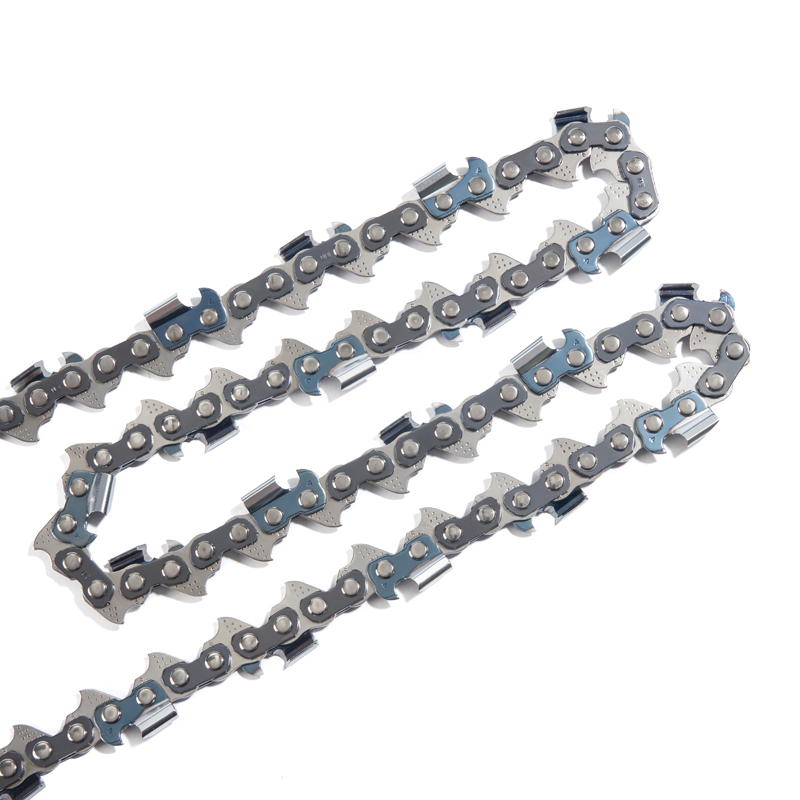
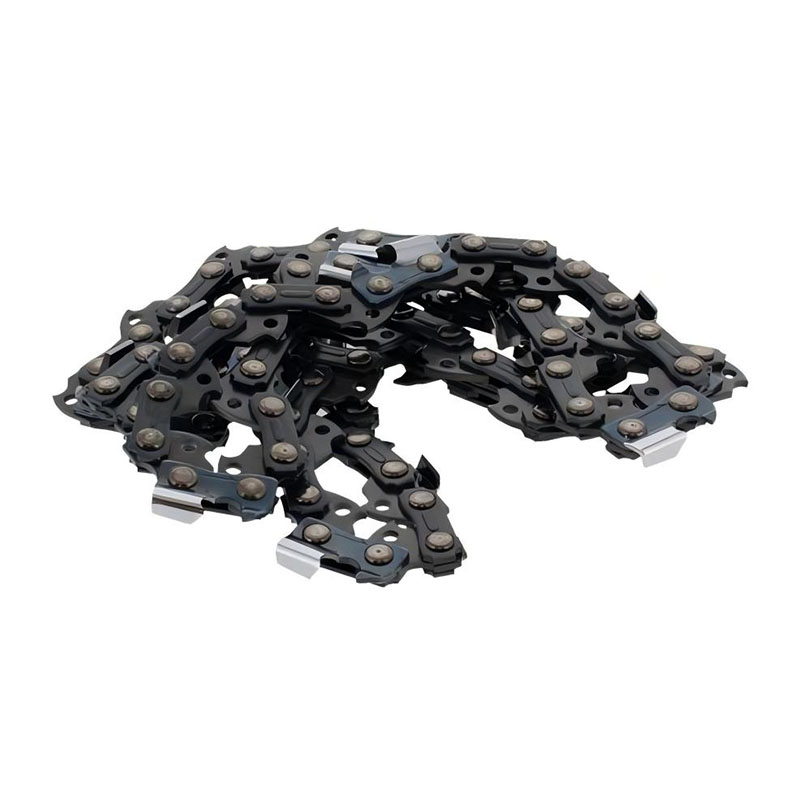
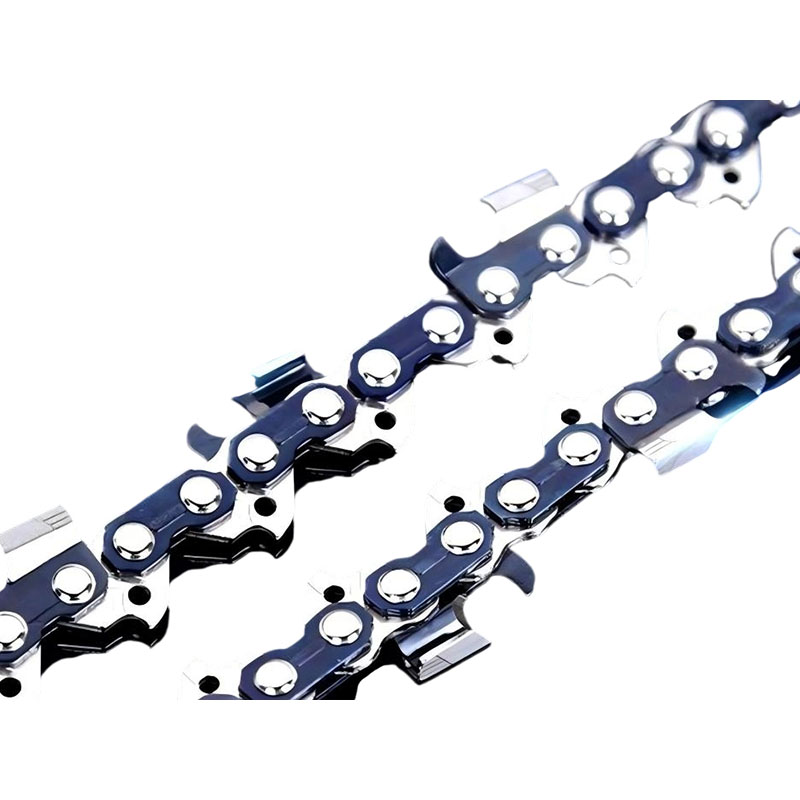
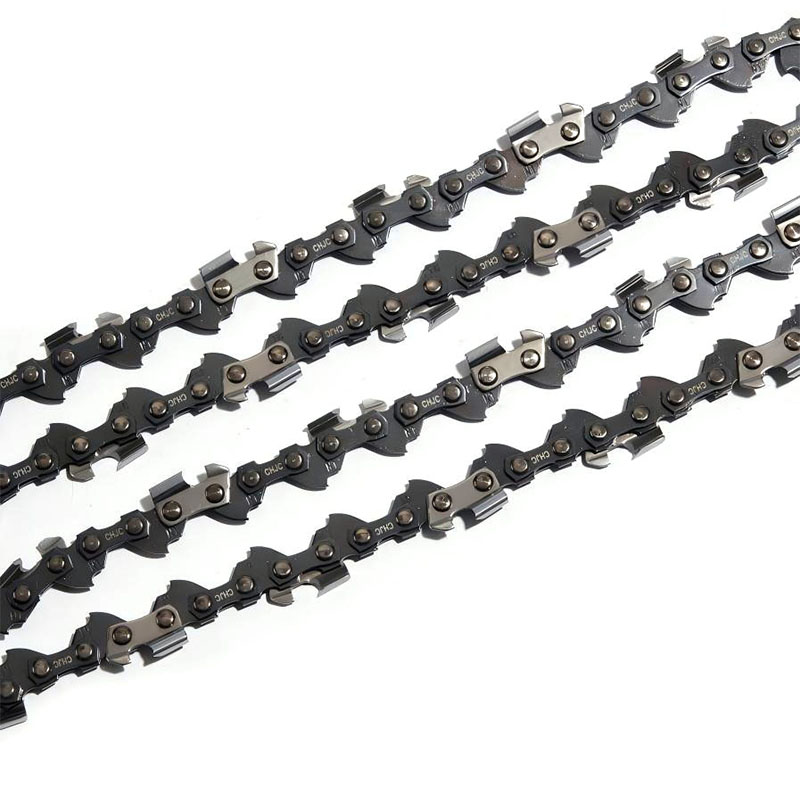
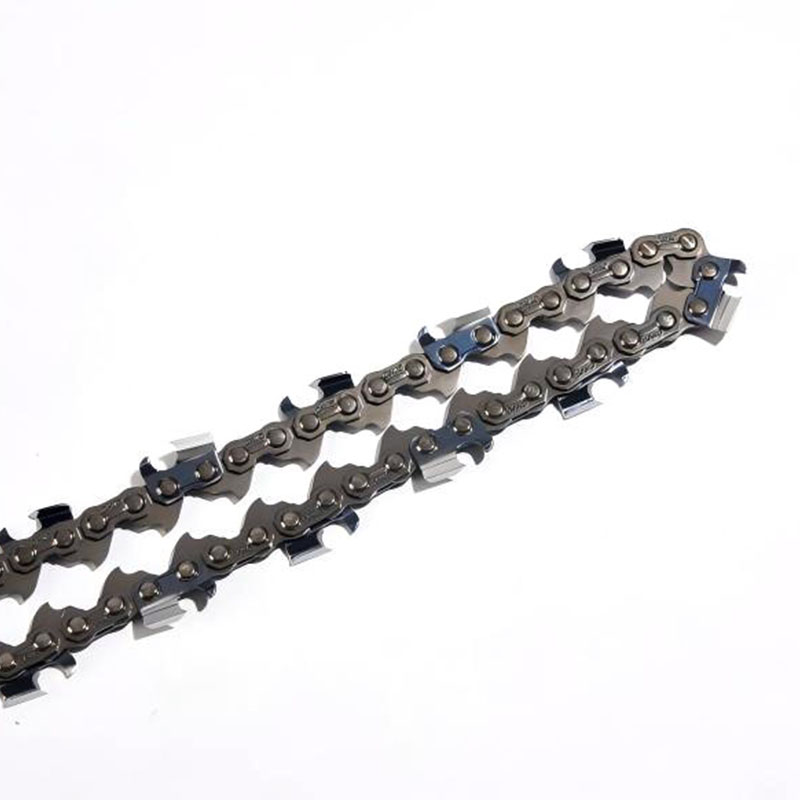
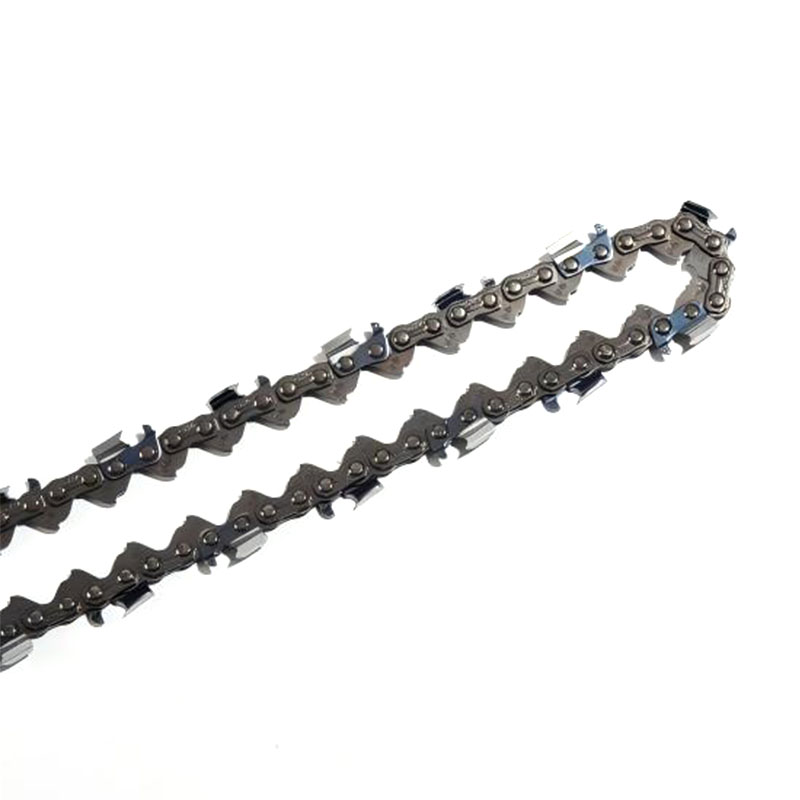
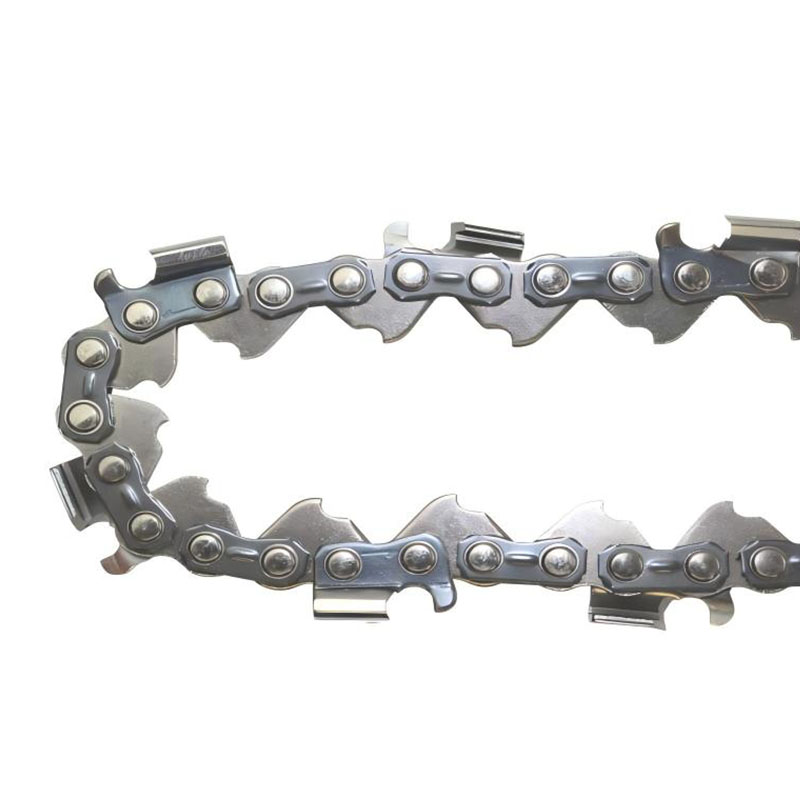
Finding the right chain for your chainsaw comes down to three numbers printed on your bar or in your owner's manual: pitch, gauge, and drive link count. Match all three to your guide bar and sprocket, and the chain will fit, run safely, and cut efficiently. Get any one of them wrong, and the chain either will not seat on the sprocket, will not seat in the bar groove, or will fit loosely enough to become a serious safety hazard. This article walks through each measurement, explains how the most common pitch families — .404" pitch saw chains, 3/8" LP saw chains, and .325" pitch saw chains — differ in design and application, and gives procurement teams and end users a practical framework for selecting the right chain for every saw and job type in their fleet.
The Three Measurements That Define Every Saw Chain
Before comparing pitch families, three terms need to be clearly understood. Confusing them is the root cause of most wrong-chain purchases in both retail and wholesale channels.
Pitch: The Most Critical Dimension
Pitch is the distance between any three consecutive rivets divided by two. It tells you which drive sprocket and bar nose the chain will engage. A chain's pitch must exactly match the pitch stamped on the drive sprocket and on the bar nose sprocket. Common pitch values in the commercial and consumer market include 1/4", 3/8" LP (low profile), .325", 3/8" standard, and .404". These are not interchangeable — a .325" chain will not run on a 3/8" sprocket without damaging both the chain and the saw.
Gauge: The Groove Fit Dimension
Gauge is the thickness of the drive link — the part that rides inside the guide bar groove. Typical gauge values are .043" (1.1mm), .050" (1.3mm), .058" (1.5mm), .063" (1.6mm), and .080" (2.0mm). A chain that is too narrow for the groove will wobble and deliver imprecise cuts; a chain that is too wide will bind. The gauge is usually engraved on the bar or listed in the saw's specifications.
Drive Link Count: The Length Dimension
Drive link count determines whether the chain loop is long enough to fit around the bar and sprocket combination. It is directly related to bar length and pitch. A 16-inch bar running a .325" chain requires a different drive link count than the same 16-inch bar running a 3/8" chain. Always confirm this number from the bar's label or owner's manual rather than estimating from bar length alone.
Pitch Family Overview: .404", 3/8" LP, and .325" Compared
The table below provides a quick-reference comparison of the three pitch families most relevant to commercial, professional, and semi-professional operations. Understanding where each belongs prevents mismatched orders and return claims.
| Pitch Family | Rivet Spacing | Typical Gauge Options | Recommended Saw Size | Primary Application |
|---|---|---|---|---|
| .404" Pitch | 0.404 inch | .063", .080" | 80cc and above; harvester heads | Commercial logging, harvesting, milling |
| 3/8" Standard | 0.375 inch | .050", .058", .063" | 50–100cc professional saws | Felling, bucking, hardwood cutting |
| 3/8" LP (Low Profile) | 0.375 inch (lower cutter height) | .043", .050" | Under 40cc; battery-powered saws | Pruning, trimming, light firewood |
| .325" Pitch | 0.325 inch | .050", .058", .063" (plus .043" LP) | 38–62cc mid-range saws | Farm work, limbing, semi-pro felling |
When to Choose a .404" Pitch Saw Chain
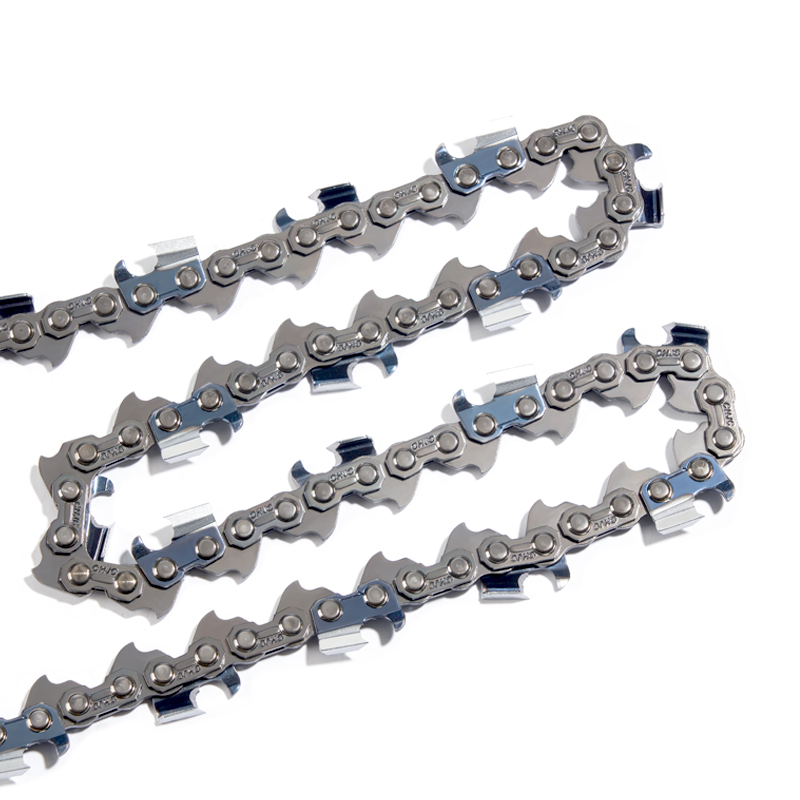
The .404" pitch saw chain is the largest pitch in standard commercial use. Its rivet spacing of 0.404 inch allows for a substantially larger cutter tooth, which removes a thick chip with each pass through the wood. This high chip load demands a powerhead that can sustain the required chain speed without bogging — typically 80cc and above for gas-powered saws, or the equivalent in hydraulic harvester head systems.
.404" chains are the industry standard in two specific segments: mechanized harvesting operations using harvester heads on forestry equipment, and large-displacement professional saws used in primary felling and chainsaw milling. The .404" .080" harvester chain variant — with its thicker .080" (2.0mm) gauge — is specifically designed for mechanical lumbering under continuous high-load duty cycles, where chain durability and resistance to drive link flex are critical. The .404" .063" variant is used in manually operated professional saws where high cutting speed in large-diameter wood is the priority.
If your saw is under 80cc, a .404" chain will exceed the engine's ability to maintain chain speed at the designed chip load. The saw will lug, overheat, and wear the chain and sprocket unevenly. Do not install a .404" chain on a mid-range saw regardless of bar length.
Typical .404" Chain Applications
- Forestry harvester heads and mechanized logging equipment
- Large-displacement professional felling saws (80cc+)
- Chainsaw milling of large-diameter logs
- High-volume softwood and hardwood processing operations
When to Choose a 3/8" LP Saw Chain
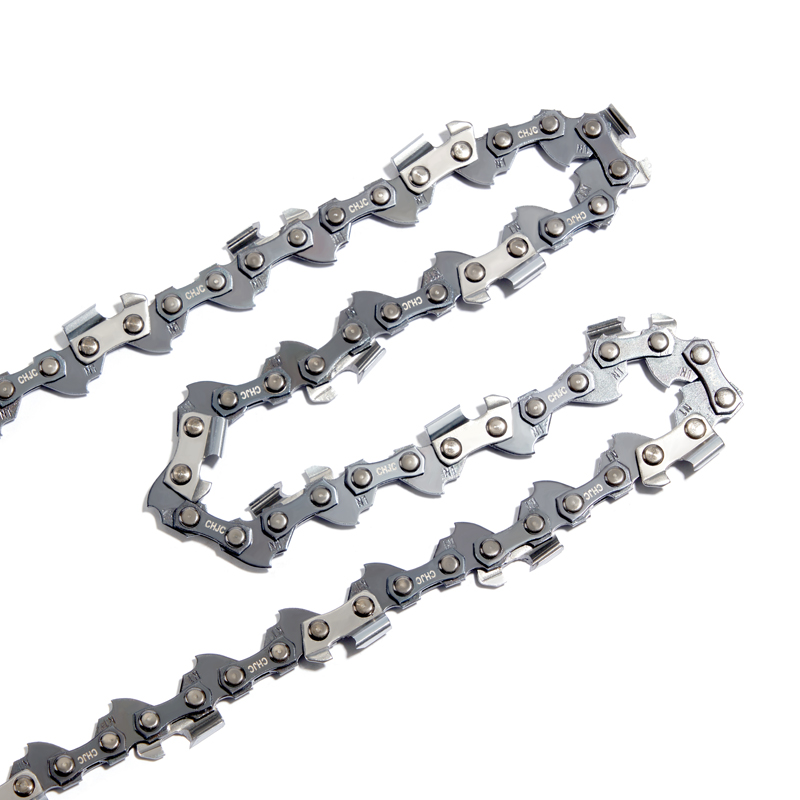
The 3/8" LP saw chain shares the same 0.375-inch rivet spacing as the standard 3/8" chain but uses a deliberately reduced cutter height and a shallower depth gauge setting. This low-profile geometry makes it the correct chain for saws under 40cc, battery-powered chainsaws, and electric-powered units where torque output is lower than a full-size gas engine.
The design trade-off is intentional: the smaller cutter takes a shallower bite, reducing the power demand per stroke to match the engine's available torque. The result is a chain that runs smoothly at the engine's designed RPM, stays in its cutting sweet spot, and produces less vibration than a standard 3/8" or .325" chain on the same small powerhead. Most factory-installed chains on homeowner and entry-level saws are 3/8" LP, which is why this pitch dominates the aftermarket replacement segment for this power class.
Low-profile cutter geometry also reduces kickback tendency compared to full-height cutter designs. Many 3/8" LP chains are certified to low-kickback standards, making them the appropriate choice for operators who perform overhead or one-handed work such as orchard pruning and tree trimming.
3/8" LP Chain Gauge Selection
Within the 3/8" LP family, gauge selection is straightforward. The .043" gauge variant is designed for the narrowest bar grooves found on compact and battery-powered saws; the .050" gauge variant is used on slightly larger saws with a wider bar groove. Always verify bar groove width before ordering — installing a .050" gauge chain in a .043" bar groove will cause the drive links to bind.
Typical 3/8" LP Chain Applications
- Battery-powered chainsaws and electric saws
- Gas saws under 40cc (homeowner and entry-level models)
- Arborist climbing saws and top-handle saws
- Orchard pruning, vineyard trimming, and landscaping work
- Light firewood cutting on small-displacement saws
When to Choose a .325" Pitch Saw Chain
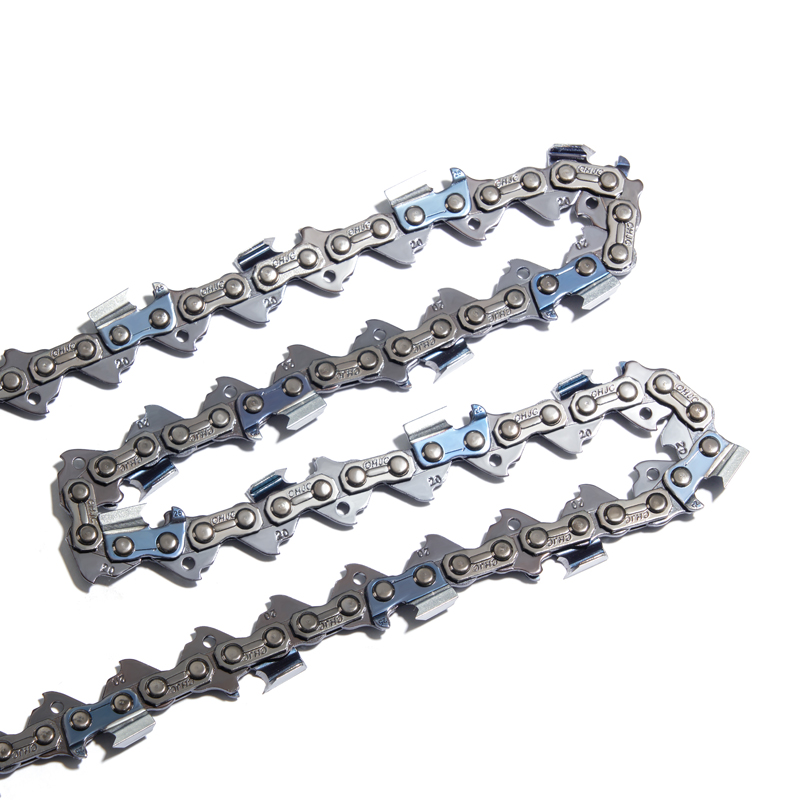
The .325" pitch saw chain sits between 3/8" LP and standard 3/8" in terms of cutter size, power demand, and cutting performance. Its 0.325-inch rivet spacing produces a medium-sized cutter that generates a narrower kerf than 3/8" standard, which means less wood must be removed per inch of cut. This allows a 38–62cc mid-range saw to maintain chain speed efficiently and deliver near-professional cutting performance without the bulk and fuel consumption of a larger engine.
In practical use, a 50cc saw fitted with a .325" chain in the correct gauge will often outcut the same saw fitted with a standard 3/8" chain, because the .325" keeps the engine in its optimal torque band while the 3/8" asks the engine to drive a chip load it was not designed to handle at full efficiency. The .325" pitch is the dominant choice for the farm, semi-professional, and mid-range dealer market precisely because it balances performance and compatibility across the most popular saw displacement class.
.325" Gauge Options and What They Mean
The .325" pitch is available in four gauge options that cover a wide range of bar specifications:
- .043" (1.1mm) — used in the .325" LP variant for compact mid-range saws with narrow-groove bars
- .050" (1.3mm) — the most common gauge for standard mid-range saws; balances chain flexibility and groove stability
- .058" (1.5mm) — used on saws with a wider groove bar; provides more lateral stability in heavier cuts
- .063" (1.6mm) — found on heavy-duty .325" applications where bar rigidity and chain durability are priorities
Typical .325" Chain Applications
- Farm firewood cutting and mixed log-diameter bucking
- Limbing and secondary cutting on 38–62cc saws
- Semi-professional tree felling on medium-displacement saws
- Landscaping companies running a fleet of mid-range saws
How to Match Chain Pitch to Saw Power: A Practical Guide
The most reliable way to select the right chain pitch is to match it to the saw's engine displacement. The table below provides the general matching rules used by equipment dealers and procurement teams across the industry. These ranges reflect the saw's ability to sustain the chain's designed chip load at operating RPM.
| Saw Displacement | Recommended Pitch | Recommended Gauge | Typical User Profile |
|---|---|---|---|
| Battery / Electric / Under 30cc | 3/8" LP | .043" | Homeowner, pruning |
| 30–40cc | 3/8" LP | .043" or .050" | Homeowner, arborist top-handle |
| 38–50cc | .325" | .050" | Farm, semi-pro, dealer segment |
| 50–62cc | .325" or 3/8" standard | .058" or .063" | Semi-pro, tree service |
| 62–80cc | 3/8" standard | .058" or .063" | Professional logger, felling |
| 80cc and above / Harvester heads | .404" | .063" or .080" | Commercial logging, mechanized harvesting |
A practical example: a 50cc saw fitted with a 16-inch bar is most efficiently served by a .325" chain with .050" gauge. Fitting that same saw with a standard 3/8" chain does not damage the saw, but the engine will struggle to maintain the larger chain's designed chip load at full operating RPM, resulting in slower cuts, more heat, and faster chain wear. Fitting it with a 3/8" LP chain is equally inefficient in the opposite direction — the smaller cutter underutilizes the available power and reduces productivity.
Cutter Tooth Profile: Full Chisel vs. Semi-Chisel
Within each pitch family, cutter tooth geometry is the secondary variable that determines cutting speed, edge retention, and sensitivity to wood contamination. Two profiles cover the majority of commercial applications.
Full-Chisel Cutters
Full-chisel cutters have a square-cornered tooth geometry that produces the fastest cutting speed in clean, dry wood. The sharp square corner removes material aggressively and is the preferred configuration for professional loggers working in clean softwood and dry hardwood. The trade-off is edge sensitivity: full-chisel teeth dull faster on dirty wood, frozen wood, or when the chain makes contact with soil or rock. Most .404" chains and professional 3/8" chains ship with full-chisel geometry as standard.
Semi-Chisel Cutters
Semi-chisel cutters use a rounded corner tooth profile. They cut slightly slower than full-chisel in ideal conditions but retain their edge significantly longer in dirty, abrasive, or contaminated wood. For farm and firewood users who regularly cut through bark, soil-contaminated wood, or wood with embedded debris, semi-chisel geometry extends the interval between sharpening cycles and makes the chain more forgiving of occasional ground contact. Most .325" chains and 3/8" LP chains for the consumer segment use semi-chisel geometry.
Key Material and Quality Indicators When Sourcing Saw Chains
For distributors and OEM buyers evaluating saw chains across pitch families, three quality variables determine long-term performance and warranty return rates regardless of pitch or cutter profile.
- Steel alloy grade: High-performance chains are manufactured from alloy steels such as 68CrNiMo3, which delivers superior hardness, toughness, and wear resistance under sustained cutting loads. This grade supports both induction hardening of the cutter edge and ductile toughness in the rivet and tie strap, preventing brittle fracture during high-stress cuts.
- Chrome plating on cutters: Chrome plating on the cutter's top plate and side plate protects against corrosion and reduces friction during cutting. Inconsistent or thin plating is one of the leading causes of premature edge wear in lower-grade chains. Request material and plating specification documentation when evaluating wholesale suppliers.
- Rivet and tie-strap geometry: A well-dimensioned tie strap reduces chain elongation (stretch) during the break-in period, which is the most common complaint metric in aftermarket chain reviews. Rivet fit consistency also determines how smoothly the chain articulates around the bar nose — critical for both cut quality and bar wear.
Manufacturers with extensive chain production experience across all pitch families — from 1/4" to .404" — and with in-house testing infrastructure covering tensile strength, dimensional accuracy, and material composition provide procurement teams with a verifiable quality baseline that reduces the risk of field failures and return claims.
Maintenance Intervals and Sharpening by Pitch
Pitch influences not only which saw the chain fits but also how it is maintained. Larger cutters hold more steel and tolerate more resharpening cycles before reaching the wear limit.
- .404" chains have the largest cutter mass and support the most resharpening cycles; they also require the largest round file (typically 13/64" or 7/32" depending on cutter geometry).
- 3/8" standard chains use a 7/32" round file and deliver a good number of resharpening cycles in clean-wood conditions.
- .325" chains use a 3/16" round file; somewhat smaller cutter mass means slightly fewer file cycles than 3/8" standard before replacement.
- 3/8" LP chains use a 5/32" file; the smallest cutter of the group reaches the wear indicator soonest, but the lower per-loop cost balances this for the homeowner segment.
Always sharpen to the correct file diameter for the pitch family. Using an oversized file rounds the cutter corner and converts a full-chisel to an uncontrolled semi-chisel profile; an undersized file leaves material at the tooth base and prevents correct depth gauge clearance.
Conclusion: Use Three Numbers, Match All Three
Selecting the right chain for a chainsaw is not a matter of preference — it is an engineering decision based on three hard measurements. Confirm pitch to match the sprocket, confirm gauge to fit the bar groove, and confirm drive link count to complete the loop. Once those three numbers are matched, choosing between .404" pitch, 3/8" LP, and .325" pitch comes down to saw displacement and the work being done.
For procurement teams building inventory across multiple customer segments: stock .404" chains for commercial logging and harvesting customers running high-displacement equipment, .325" pitch chains as the core SKU for the farm and semi-professional segment, and 3/8" LP chains for the homeowner and battery-saw segment. Carry at least two gauge options per pitch family to cover the range of bar specifications in each segment, and verify material grade and plating specifications before finalizing any wholesale sourcing relationship. These decisions, made correctly at the sourcing stage, are the most reliable way to reduce field returns and build long-term customer confidence.